
UCI Esports App
The official companion app for UC Irvine Esports


My Role
Lead UX/UI Designer
Timeline
Janurary 2026
Status
MVP Shipped
Skills / Tools
Figma Mobile Design iOS & Android
Overview
Meet UCI Esports — the first official esports program at a public university.
In 2016, the University of California, Irvine launched the nation’s first official public university esports program.
Today, UCI Esports offers varsity teams, scholarships, community events, employment opportunities, and a dedicated gaming arena.
Problem
Declining engagement & funding
Post-COVID, the program has seen a major drop in arena visits, making it harder to maintain the same level of activity, funding, and community presence it once had.
While UCI Esports still offers valuable resources and events, many students and community members are either unaware of what the program provides or lack a convenient way to stay connected.
The Challenge
Create a companion mobile app for UCI Esports to support initial discoverability, program visibility, and long-term engagement.
Guiding Question
How do we build a mobile app that fosters the gaming community and encourages people to engage with UCI Esports?
Solution
A digital home for UCI Esports.
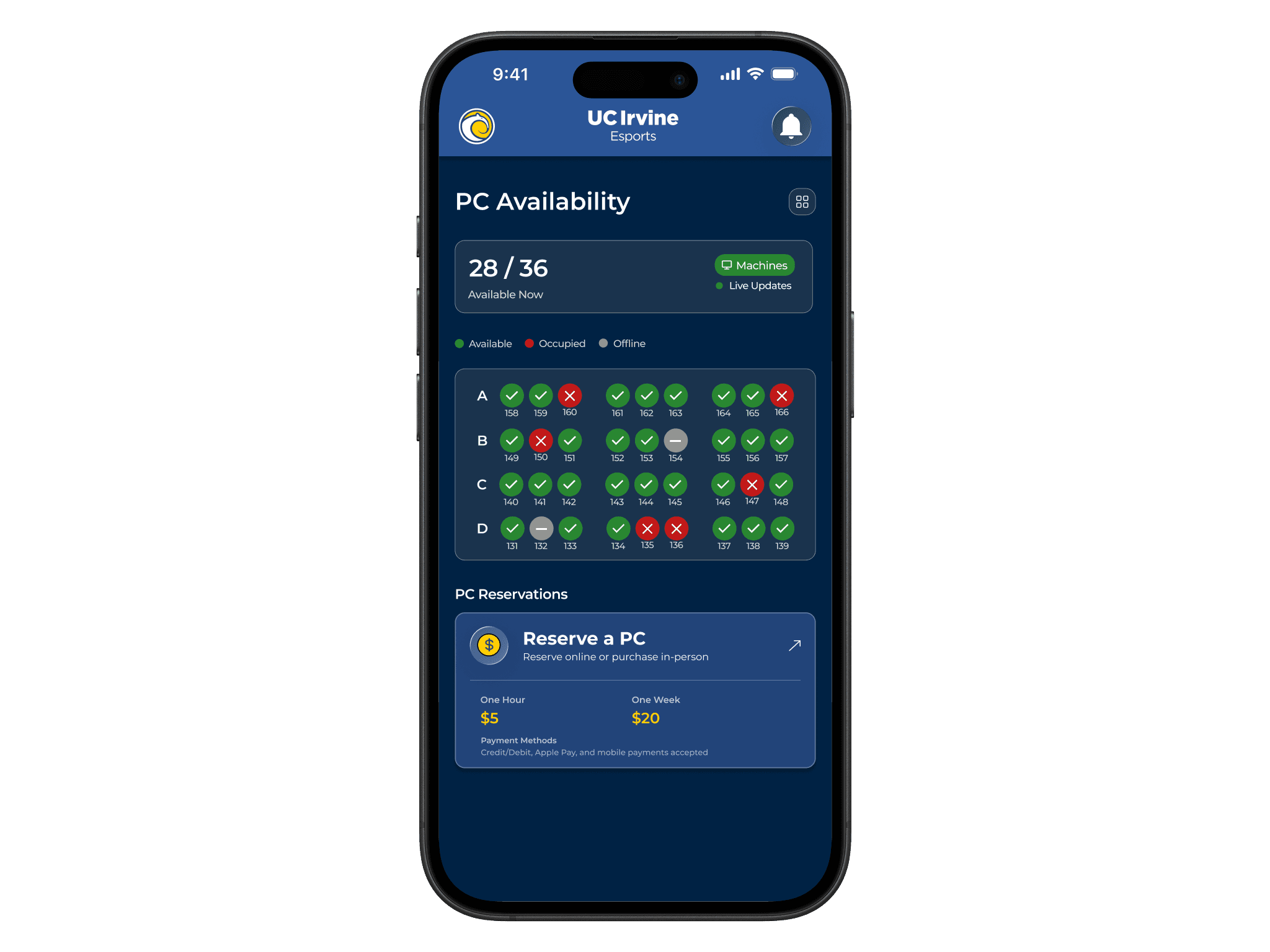
Real-Time Availability
Live operating status and PC availability across all stations, updated in real time.
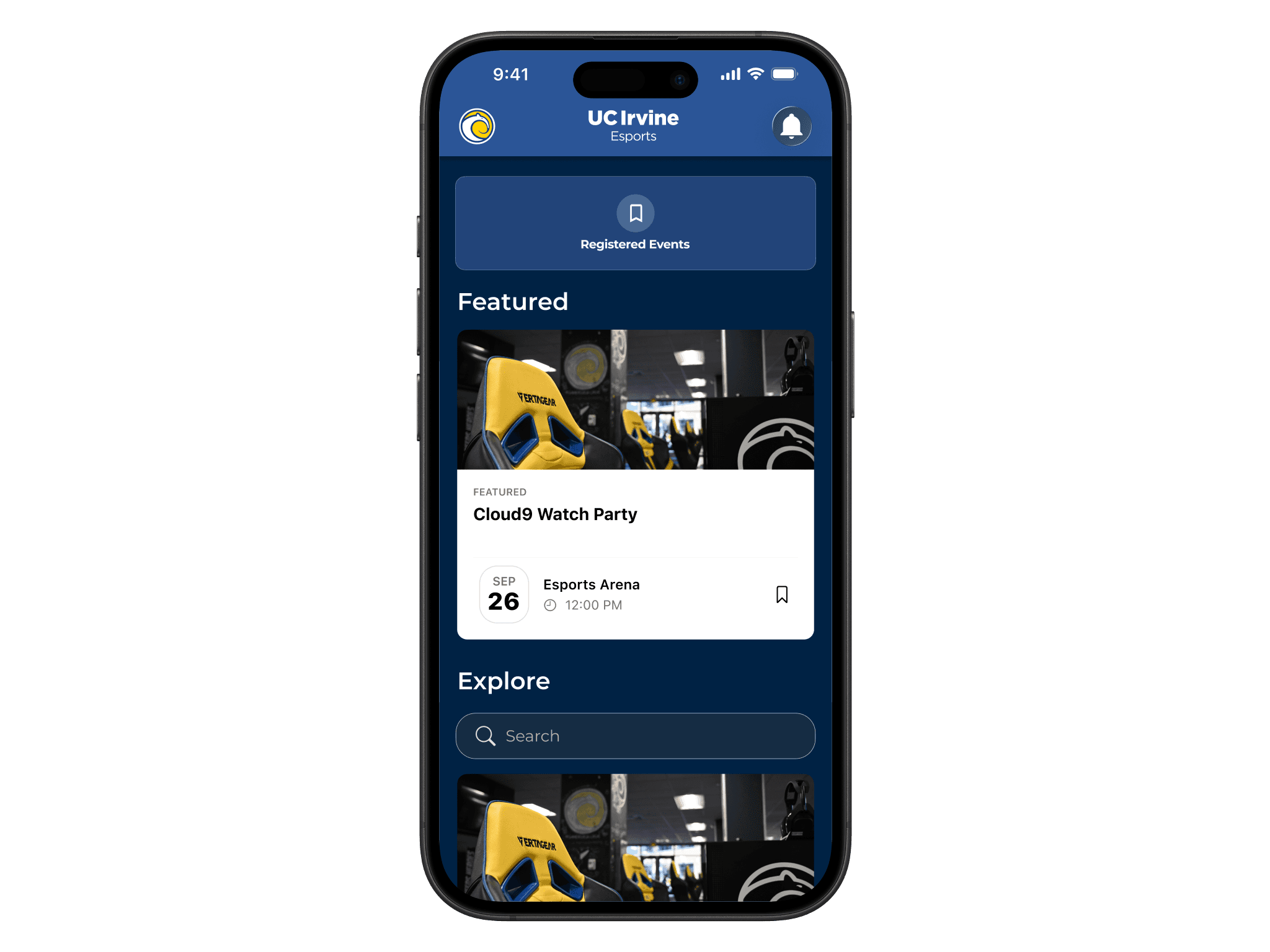
Events Calendar
Browse upcoming events, register in-app, and track everything you've signed up for — all in one view.
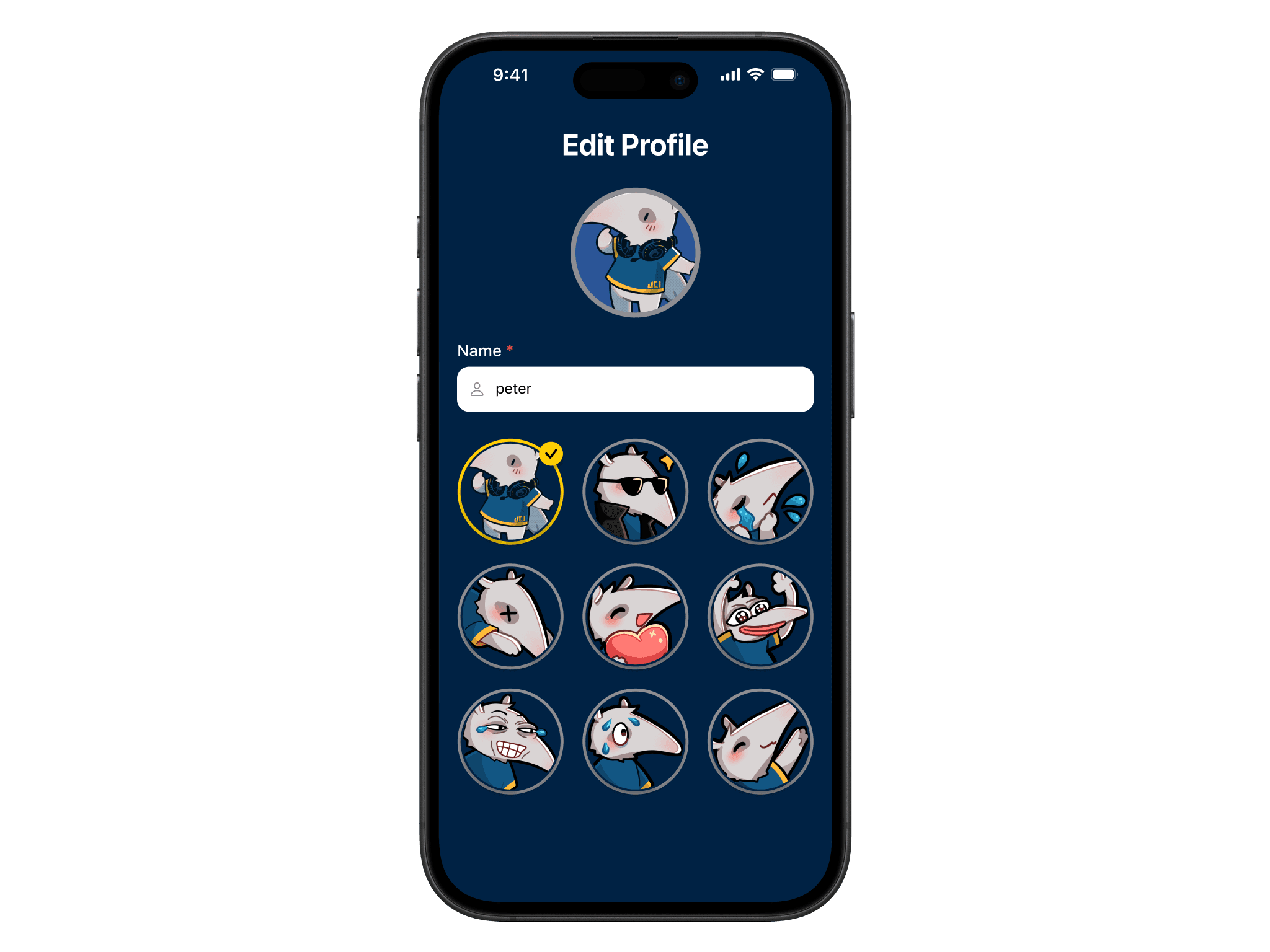
Profile Account
Earn XP through arena visits and events to unlock rewards, prizes, and exclusive perks.
Research
Getting to know my audience.
User Insights
Students & Visitors
Goal
Access the arena and discover events without friction.
Pain Points
Arena Staff
Goal
Keep operations running smoothly with fewer manual touchpoints.
Pain Points
Program Leaders
Goal
Analyze engagement and growth metrics.
Pain Points
Constraints
Working with constraints.
GGLeap API
Because all live arena data lived inside GGLeap's system, every real-time feature depended on what their API could expose. This meant scoping features around API capabilities rather than user needs alone, and designing fallback states for data that wasn't reliably available.
Stakeholder Approval
Design decisions needed to align with UCI Esports leadership and their vision for the program. This meant navigating feedback cycles and balancing user needs with institutional priorities throughout the process.
Ideation
Exploring solutions and defining requirements.
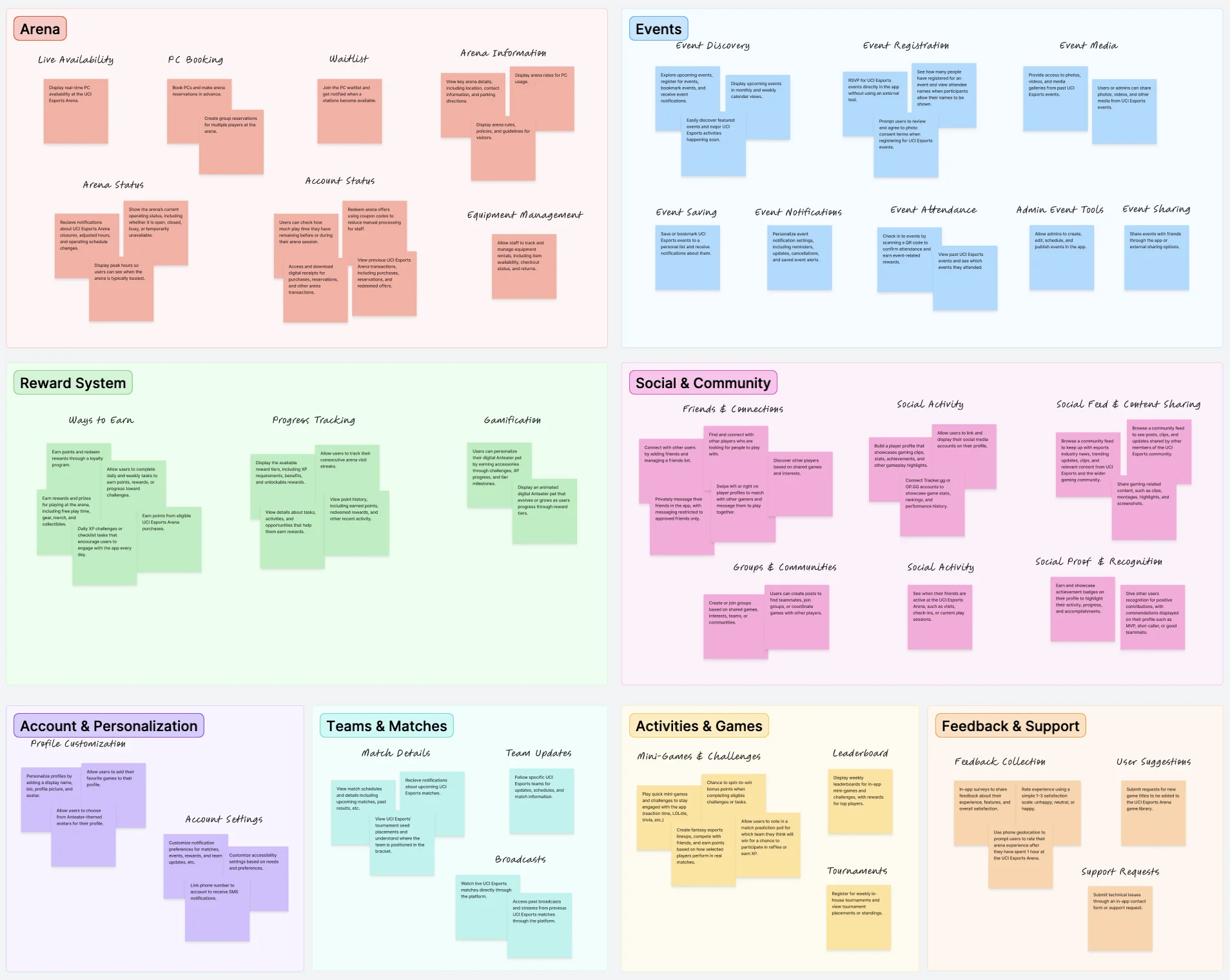
Based on research insights, I translated user pain points into concrete feature requirements. The goal was to identify features that would address critical needs across all three user groups while remaining feasible within project constraints.
Design
Bringing it onto the canvas.
Based on research insights, I translated user pain points into concrete feature requirements. The goal was to identify features that would address critical needs across all three user groups while remaining feasible within project constraints.
Reflection
Looking back
My first time designing a product across design, development, and leadership
This project taught me that designing a real product is not just about creating polished screens. It is about aligning people, priorities, and constraints around a shared direction. Because the UCI Esports app involved leadership goals, developer constraints, and many possible feature ideas, I learned how important it is to communicate clearly, prioritize intentionally, and design with implementation in mind.
Here are my main learnings from this project:
Design-dev alignment needs to happen early.
I learned that even strong mockups can lead to misalignment if design intent is not clearly documented. Platform-specific patterns, native components, and technical constraints can all affect the final product, so I learned the importance of clearer handoff specs, reusable components, and ongoing communication with developers.
Cross-functional collaboration means balancing different priorities.
This project involved feedback from leadership, marketing, HR, and mobile development. I learned how to translate broad organizational goals into product decisions while still keeping the user experience clear and focused.
Scope needs to be protected.
Because the app could support so many areas of UCI Esports, the feature list grew quickly. I learned how important it is to prioritize the MVP around the features with the greatest user impact, technical feasibility, and value to the program’s immediate engagement goals.